
FAC Insights: Young Urban Arts Foundation
FAC Insights is a forum for us to showcase and share long form pieces looking at various parts of the music industry and the society that shapes it. Pieces take the form of videos, interviews, discussions, articles and more.
In this piece, we’re excited to feature Kerry O’Brien from the Young Urban Arts Foundation (YUAF), who shares how the organisation is breaking down barriers for young people through music, mentorship, and community-led programmes, helping to unlock creative potential and create pathways into the industry.
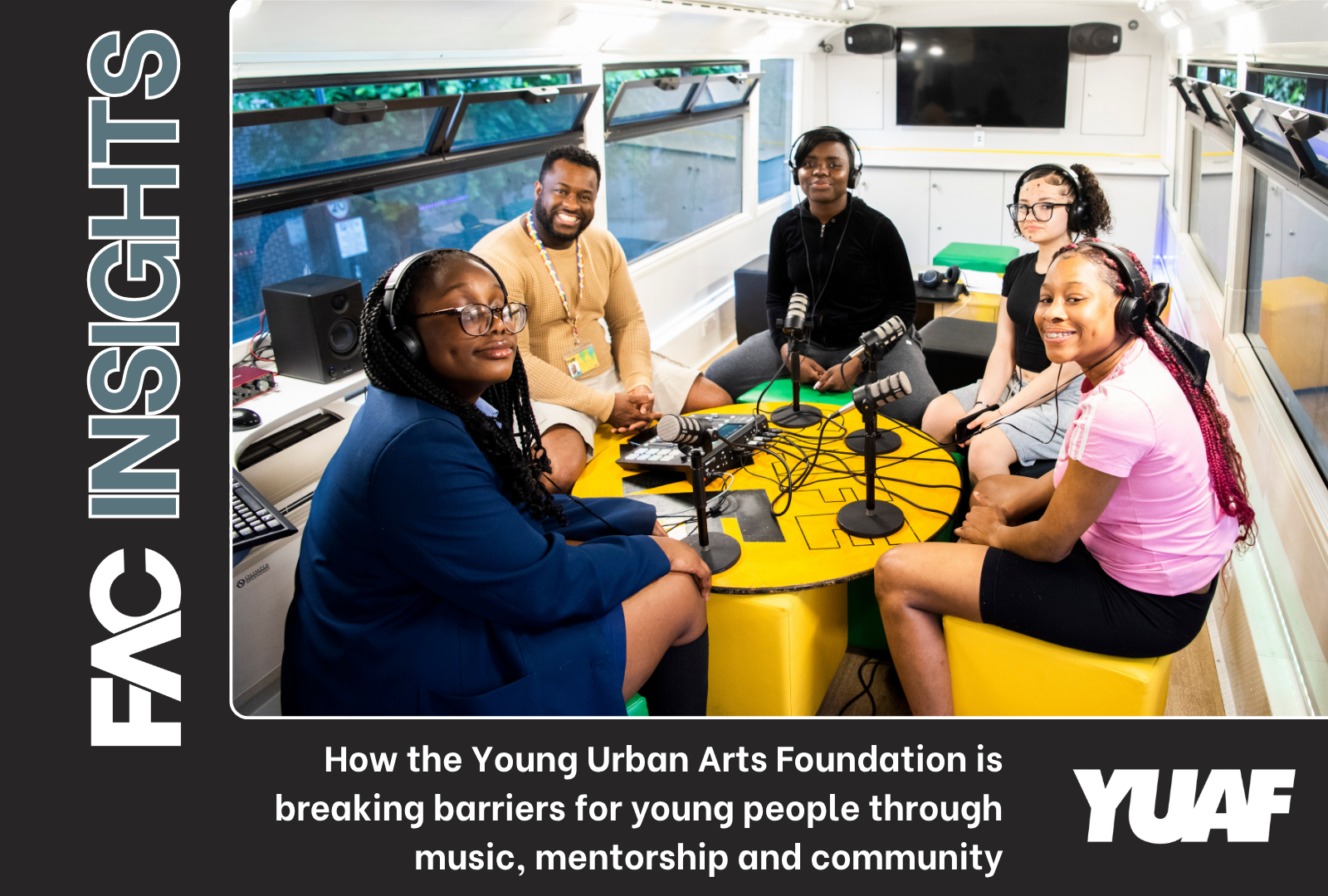
Could you start by telling us more about the work YUAF does and the mission behind it?
Young Urban Arts Foundation exists to make sure that young people with creativity and potential don’t get locked out of opportunity because of where they come from.
We work mainly with young people facing real challenges, whether that’s exclusion from school, involvement in violence, or simply not having access to environments where their creativity is taken seriously.
One of the ways we do that is through our Studio Bus, which is a fully equipped mobile music studio that travels directly into communities across London. For us the bus is just the doorway. Once a young person steps inside and begins creating, the deeper work starts, mentoring, confidence building, and helping them recognise the value of their own voice.
At the heart of YUAF is a simple belief: young people deserve to be seen, heard and celebrated, and creativity can be a powerful way for that to happen.
How do you ensure your programmes uplift marginalised voices and avoid replicating structural inequalities young people already face?
For us it begins with listening. Young people understand their realities better than anyone, and if organisations aren’t genuinely listening to them it’s very easy to unintentionally recreate the same structures they’re already navigating.
We design our programmes with young people rather than simply delivering something to them. That means paying attention to the obstacles they experience ,confidence, access to equipment, financial pressures, or simply feeling like they don’t belong in creative spaces.
By bringing professional equipment and creative opportunities directly into communities, and connecting young people with mentors who understand their experiences, we create environments where their culture, ideas and identity are valued.
Ultimately our work is about creating spaces where young people feel seen, heard and celebrated, and where their creativity is recognised as something meaningful.
YUAF partners with organisations like Sony Music Entertainment UK and uses mentoring and industry connections to help young people move into creative careers. How effective have those partnerships been, and what barriers still remain?
Partnerships across the industry have been incredibly valuable because they allow young people to see possibilities that might otherwise feel completely out of reach.
When someone working in the industry sits down with a young person and explains how things really work, whether that’s production, publishing, A&R, marketing or management, it helps break down a world that can often feel closed or intimidating.
Over the years we’ve collaborated with organisations including Sony Music Entertainment UK, PRS for Music, Amplify and Seed Marketing, Ditto Management, and Disney Pictures, who have supported our work through mentoring, insight sessions and opportunities for young people to connect directly with people working in the sector. Those interactions can be incredibly powerful. When a young person realises that someone working in the industry is willing to share their knowledge and experiences, it can shift how they see their own future.
That said, real challenges still exist. The creative industries are still heavily relationship-driven and often rely on informal networks or unpaid opportunities. For many talented young people, particularly those from underserved communities, that can make the first step into the industry extremely difficult. That’s why meaningful partnerships matter. When industry organisations work alongside community programmes, it becomes possible to create real bridges into opportunity.
How has YUAF adapted or evolved its programmes over the years to respond to changes in youth culture, technology or social issues?
Youth culture evolves quickly, and if organisations don’t evolve with it they risk becoming disconnected from the young people they’re trying to support.
When we first started, much of the work centred on studio access and creative workshops. Over time we’ve expanded that to include conversations around creative identity, entrepreneurship, digital platforms and wellbeing, because those are all part of how young people are navigating the world today.
But one thing hasn’t changed. Young people still need spaces where they feel respected, supported and encouraged to express themselves. When young people feel seen, heard and celebrated, it builds confidence that can ripple into every other part of their lives.
What can the wider music industry learn from your work about empowerment, representation and diversity?
One of the most important lessons is that representation isn’t only about who appears on stage, it’s also about who has access to the rooms where decisions are made.
When young people see producers, engineers, executives and creatives who understand their backgrounds and culture, it changes how they see their own potential within the industry.
Another key insight is that talent is everywhere. Communities that are often described as “hard to reach” are actually full of creativity and innovation. What’s often missing isn’t ability, it’s opportunity, networks and encouragement.
If the industry wants genuine diversity and fresh ideas, it has to build authentic relationships with communities and invest in young people long before they appear on anyone’s radar.
How do you ensure that your work remains relevant, culturally sensitive and youth-led?
The simple answer is proximity. We stay connected to the communities we serve.
Our programmes evolve through continuous dialogue with young people, through conversations, feedback, and simply spending time in those spaces listening to what’s actually happening in their lives.
Young people are often far ahead of institutions when it comes to understanding culture, trends and social shifts. Our role is to create the space where their perspectives shape the work, rather than assuming we already know the answers.
When young people feel ownership of the space, they’re far more likely to thrive within it.
What role do you believe the music and creative industries should play in nurturing young talent, particularly from underserved communities?
The creative industries have a huge role to play here. Music and culture have always been driven by young people and by communities pushing creativity forward.
If the industry wants to remain innovative and relevant, it needs to invest in the next generation in meaningful ways, not only through talent discovery, but through mentorship, knowledge-sharing and infrastructure.
Supporting grassroots organisations, opening up networks and sharing industry expertise can make a huge difference. Talent development often begins long before someone releases their first track. When young people feel recognised and encouraged, it builds confidence and ambition that can shape their entire future.
Looking ahead: what are the biggest ambitions for YUAF in the next 5–10 years?
Our ambition is to deepen and expand the opportunities we’re creating for young people. One of our biggest priorities is scaling the reach of the YUAF Studio Bus. It’s an incredible resource, a fully equipped mobile music studio designed to reach young people directly in their communities but at the moment it’s only operating around nine hours a week. With the right financial support, it could be reaching hundreds more young people across London every week.
The demand is there, the communities are there, and young people are eager to engage. What we need is the investment that allows us to bring that resource to more places, more consistently.
Alongside that, we want to continue strengthening progression routes into the creative industries, connecting young talent with mentoring, training and meaningful opportunities.
Ultimately this work is about more than delivering programmes. It’s about expanding what they believe is possible for their lives and futures.