
FAC Insights: Centring the wellbeing of racialised communities in Scotland’s creative industries
FAC Insights is a forum for us to showcase and share long form pieces looking at various parts of the music industry and the society that shapes it. Pieces take the form of videos, interviews, discussions, articles and more.
In this piece, we’re pleased to feature Matt Hickman, co-founder of Creative Balance, discussing the organisation’s research into the mental health and wellbeing of racialised creatives in Scotland. Matt explores the challenges of isolation, tokenism and economic precarity faced by Black and Global Majority artists, highlighting the need for more inclusive, accessible and community-led spaces. He also shares Creative Balance’s plans to build on its findings and advocate for a more supportive and equitable creative sector.
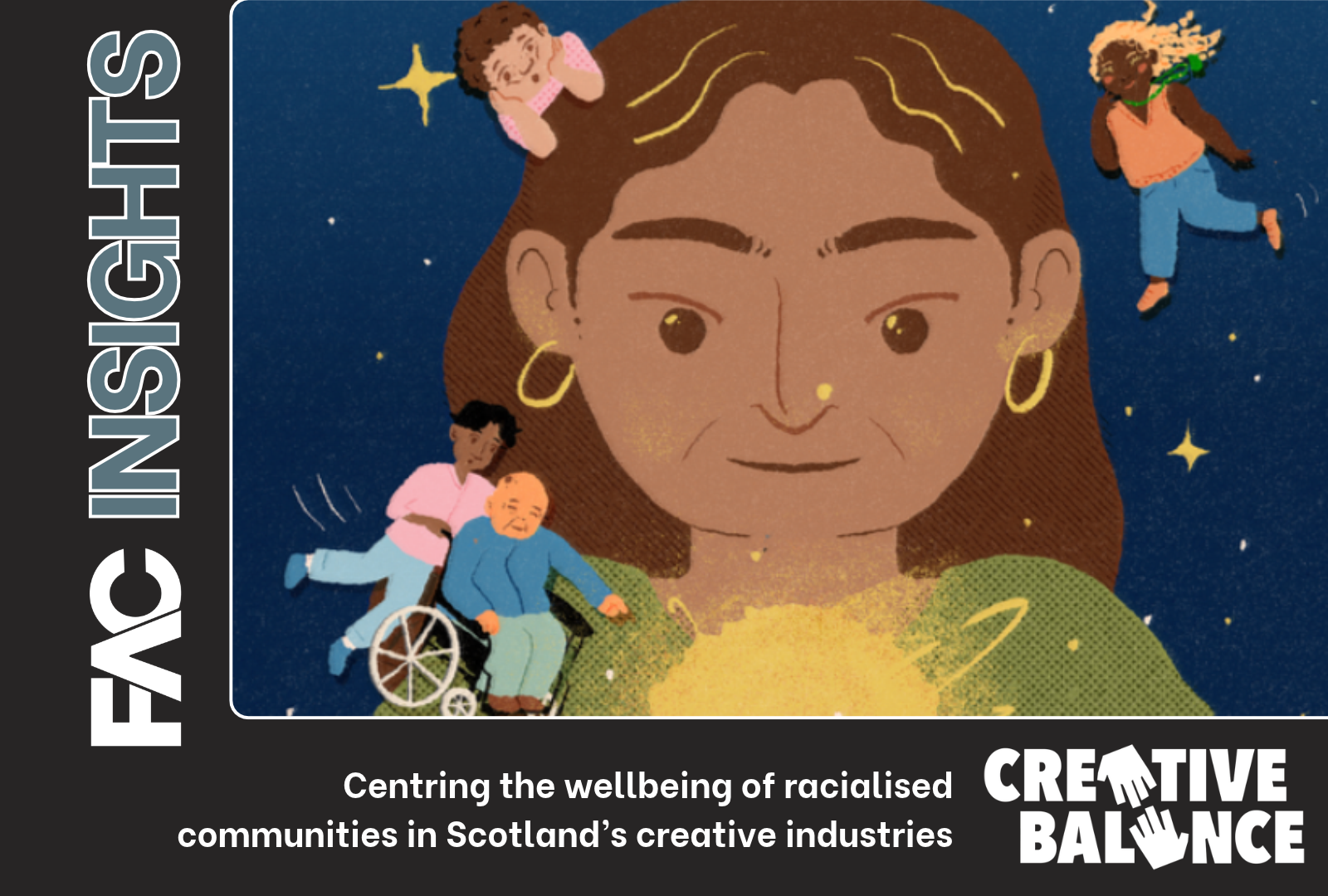
Can you give us an oversight of what Creative Balance is, and why you do the work that you do?
Creative Balance is a research initiative in Scotland that is cantered around the mental health and wellbeing of racialised creatives in Scotland. It was formed by myself (Matt Hickman) and Halina Rafai in 2023 in response the ever growing issues we found in the culture sector in Scotland as freelancers and artists of colour ourselves, but also from our peers. It was clear that while race and inclusion had become a talking point, it was often through a white-led lens and rarely did we speak to Black or Global Majority creatives who felt that space was truly being held for them. The result was most artists were beginning to feel like a ‘tick-box’ rather than fully valued people and artists. We decided we needed to make a chance and that one of the most effective things we could do to change perceptions was to have the data, and the stories, to back up what we were hearing on the ground. We then brought on Loa Pour-Miza to lead the research and began phase one of our work to investigate wellbeing for racialised creatives in Scotland.
How did you go about this research?
One of the very first things that we agreed as a team was that everything we did as an organisation should be for and by the community. We put a call out to have a steering group that helped us shape what the research would be, and how it would look. For us as a team, it is vital that community is at the heart of everything we do. We have a model where everyone has their time paid, and access to therapeutic support for engaging with us. You have to start at home if you are going out in the world to ask others to make positive changes.
We ran group sessions using creative methods - including collage-making, group discussion and storytelling - to explore what wellbeing means for our communities. This approach moves away from traditional research frameworks and creates space for participants to share experiences on their own terms. We wanted the data to be more than numbers or surface level.
When you do a call out for research like this, you are never going to reach everyone so inevitably some groups were missed out, whether that was by age, location, gender or artform, amongst many other things. To try to ensure that this research was as diverse and inclusive as possible, we decided to commission select case studies with artists who fit the backgrounds missed from the call out to attend the groups. We hope that this helped paint a truer and fairer picture for as many people as possible within the research. I think it was interesting to focus more on the people, and their experiences, than the numbers. We hope this further humanised the research.
What were the key findings of this research and what do those findings tell you about the current state of the arts & culture sector in Scotland, and perhaps the UK?
The key findings from our phase one research ‘Finding the radiance in between’, which can be read in full here https://www.creativebalance.scot/finding-the-radiance , were ‘isolation’, ‘tokenism’, ‘economic precarity’ and the need for ‘B-POC Led Spaces’.
There was a strong feeling by many participants that in being a racialised creative in Scotland you were made to feel like an outsider, not just in the arts sectors but also in the country itself. This enhanced the feeling of isolation as an artist or freelancer.
The severe lack of diversity within the sector, especially in senior roles was seen as a massive barrier to moving forward as an artist. On top of this, funds popping up constantly looking for ‘diverse’ candidates that were racialised in nature, or tokenistic, led to a feeling of being a tick-box and again, further isolated as a creative.
On the theme of BPOC led spaces, participants were given space not just to discuss the lack of them, but also to envision just what those spaces could and should look like.
Two things that stood out for me personally were the focus on accessibility in spaces from inception as well as the need for them to be multi-purpose. It won’t be news to anyone that many creatives in our communities also have multiple practices, and roles both by choice and by design to be able to navigate their lives as freelances and artists in Scotland’s creative sector.
What does the future hold for Creative Balance?
We have just finished hosting our first ever Wellbeing Festival in Glasgow. It was a beautiful occasion and a real success. It was amazing to see people from across the different art sectors come together and celebrate wellbeing and mental health. There will definitely be another festival next year. We are also starting to look towards our next steps with phase one research as we engage with arts organisations across Scotland with the findings, and hopefully some recommendations about how we can all build more inclusive spaces and practices that centre and uphold the mental health of artists and freelancers. The response has been hugely positive, most organisations do want to do more and to do better, that is a great place to start from. On top of this, we are starting to look at the next phase of research that will centre around wellbeing in the context of ‘Race & Class’ in Scotland. Social economic deprivation came up several times in phase one, as well as the idea of a Universal Basic Income for artists. With a basic income for artists now agreed as a priority for this parliament by the Scottish Government, we are looking to work with the amazing team at Basic Income For Artists Scotland, as well as the wider sector, to ensure that wellbeing is included in the design of that pilot and barriers such as gender, class, disability and race are considered as factors for consideration when rolling out the scheme.
We remain grateful for the support given by Creative Scotland, Culture Counts Engender, Equal Media and Culture Centre (EMCC) & The Baring Foundation for their support and funding. Thanks to amazing organisations like FAC for allowing us the space to tell our story and hopefully reach more amazing creatives.