
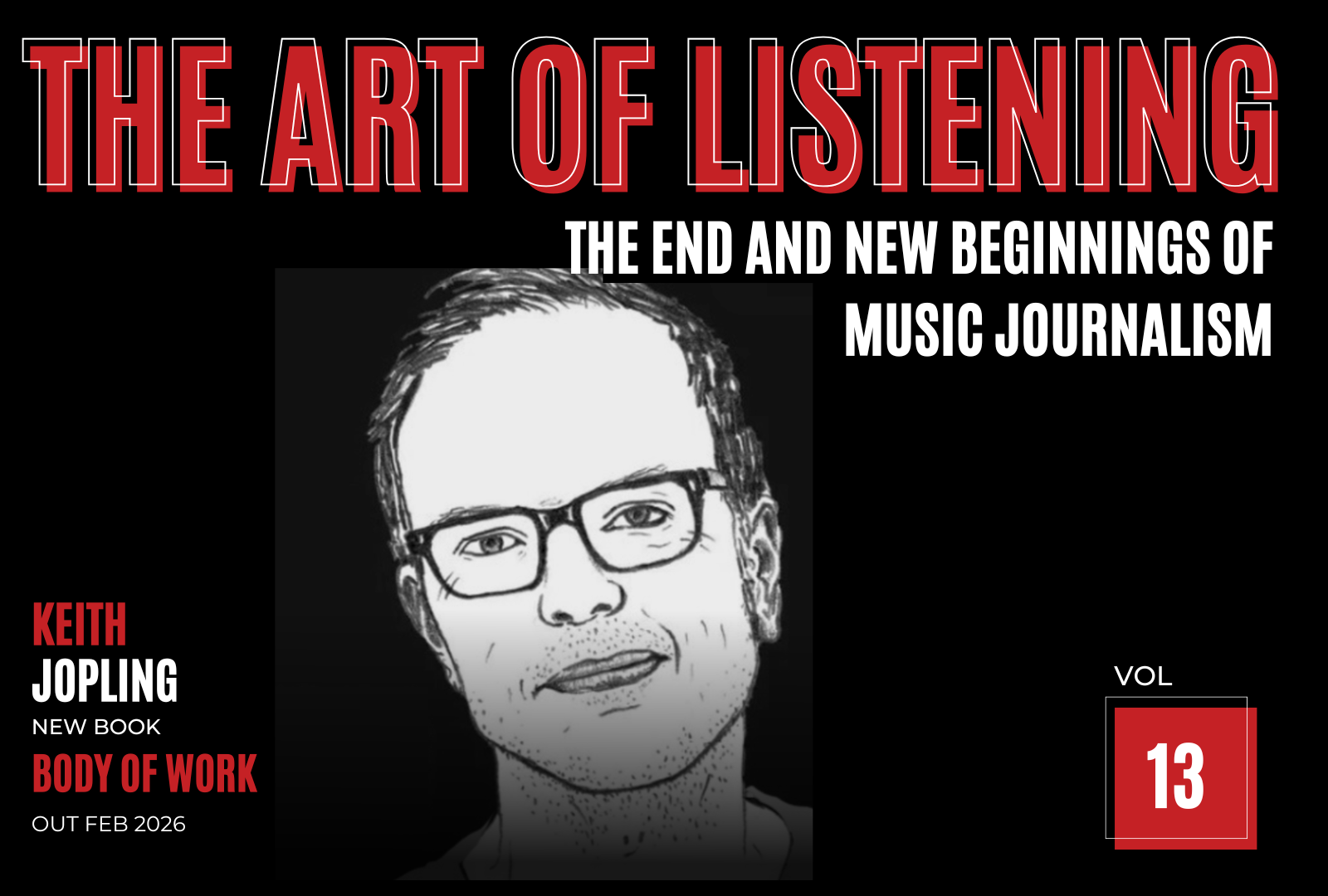
Art of Listening #13 with Keith Jopling
In this edition of The Art of Listening, Keith explores the rise, fall, and new beginnings of music journalism. From the closure of iconic magazines like Q and Melody Maker to the growth of niche zines, Substack newsletters, and artist-led media, he examines how music coverage is evolving and what “dream press” looks like for artists today. A reminder that his book Body of Work: How the Album Outplayed the Algorithm and Survived Playlist Culture will be published 10th February 2026.
In the scholarly work on the golden era of music magazines, Totally Wired, Paul Gorman states that “The first years of the 21st century following the demise of Melody Maker, Select and others were not kind to print publications in general and the music press in particular”. As the century has progressed, this reads like an understatement. The list of folded magazines (pun intended) in the UK and USA is piled high. Most notably in the UK, once Q Magazine bowed out in 2020, it signified the end of the popular music magazine and the ushering in of the strictly niche music media era. Q’s original founder David Hepworth warned the music industry “You will miss the music press. Our job was to make the artists sound more interesting than they are”. True indeed. A mainstream press interview or feature with a musician these days is nowhere near as much fun. Instead, it can sometimes feel like you’re reading a cutout from a template, as follows: artist has some early success, encounters some form of trauma and struggles with mental health, finds a way to focus on the latest project, bounces back with a new album and renewed sense of empowerment, etc. Music writers need to become self aware that sticking to this formula will eventually put them out of work, because AI could write articles like this. Music magazines such as Q brought more glamour, irreverence and sometimes triviality to the stories behind the artists. Then again, it was a different era and the focus was not so much on creators’ struggles as much as their brand of rock & roll lifestyle.
But the music press fulfilled a much bigger, multi-faceted role than bigging up the artists. The end of music magazines meant the decline of criticism and the music review. It meant the end of tastemaking at least in print, and a free for all when it comes to discovery and recommendation (well, do you rely on algorithms to drive your tastes?). Mostly, it brought the sad disappearance of an immersive couple of hours of losing oneself in a curated world of words and pictures simply not replicable in an online environment. Flicking through pages beats the hell out of scrolling.
As if it couldn’t get any worse for the music press, in January 2024, Condé Nast announced it would merge Pitchfork into GQ, including big staff cuts at the biggest ever digital-native music magazine. Pitchfork really was the last music media empire. It grew from a humble blog into a multi-revenue music media business, eventually succumbing to an acquisition by an unlikely mothership in Condé Nast, at a time when traditional publishers desperately needed ‘digital first’ media properties. No other music media brand has succeeded on any meaningful scale since. We cannot put the genie back in the bottle when it comes to the commercial viability of music magazines. Pitchfork's heyday lasted well over a decade - not a bad run, even compared with legendary brands of the golden age of music journalism, like Melody Maker or NME (and Q had a run of some 34 years in print).
Pitchfork’s digital presence made it more than just an editorial brand. It became a destination for music lovers, aficionados and obsessives, outgrowing its original “white male hipster” tone of voice to become more inclusive and diverse. It launched a music festival in Chicago in 2016 and in true music mag form, could claim a lot of credit in launching artist careers, by way of a high-scoring review. Curiously, in the couple of years since that fateful announcement, Pitchfork seems to have carried on regardless, churning out essential material at the same rate even with a fraction of its former resources. If anything, it may have gotten a tiny bit more relevant. It’s infamous 8.something (and higher) review scores are marked with a red arrow in the top right corner of the album cover thumbnail, and those reviews seem to have just as much impact as ever (relatively speaking, given the overall weakening power of the critical review - see another edition for more on this). Pitchfork managed to pick itself up and dust itself off even to the extent of launching a (quarterly) physical “zine”. As newly appointed editor Mano Sundaresan boldly declared:
“Consider this the start of a new era for Pitchfork, one defined by big music stories that have gone untold and a return to our roots in passionate music journalism”.
So now, can “niche” music media thrive? I’m optimistic that the answer is a tentative yes, if not a resounding one. The NME also launched a physical edition in 2023, while Rolling Stone and Clash also continue to publish print versions. Best of the bunch for me is So Young, a Southampton, UK-based ‘zine’ built around the resurgence of guitar bands, the post-punk and alternative indie/pop scene. On a modest scale, it has built a fan community, subscriber base, a rather cool merch brand, and has branched out into a small label and live music booking agency. Founders Josh Whettingsteel and Sam Ford present their brand of music journalism as conversational, empathetic interviews; the enterprise has a supportive feel to it. As So Young advocates for the artists it features and those artists continue to value it and pay back the compliment as they grow, the brand grows in strength. It is a low key celebration of a cultural scene; viable, albeit on a small scale. So Young feels like the way to build a music media brand in the 21st century - expand a zine into a real ‘business’ - merch, talent management or a record label, for example. ‘Media’ won’t get much beyond a few free tickets and a cup of coffee, but a brand with a community is a different beast.
For a while there, it looked like music streaming platforms would be the all consuming apex predators, including appropriating the role of music journalism. Spotify’s editorial playlists such as Rap Caviar took over the tastemaker and discovery function of magazines, but also served up the music directly, making the magazine function irrelevant. But, editorial takes effort, creativity and commitment and Spotify gradually backed away in favour of hyperpresonalisation and the algorithm - much more in the tech wheelhouse. Now the window is open again for music media and curators.
This is good news, because music magazines celebrate the art of music better than any other medium. When I went to meet Guy Hands after he had purchased EMI way back in 2008, I took in a pristine copy of the latest issue of Clash. I wanted to demonstrate to Hands that he had bought into a phenomenon - how music goes way beyond CDs, ringtones, and downloads (now streams of course) but bled over into fashion, art and cultural scenes. The editorial and curation function is a huge value add, and packaging it all together into a single source is the only way to convince fans and readers to pay good money for the privilege of finding out about music.
Online, the only way to monetise a magazine style offering it seems, is to move away from the written word, to video or audio/podcast. At least that way, there is distribution, by way of the usual giant social media and streaming platforms. Enter the new music journalism - influencers. Anthony Fantano’s The Needle Drop, Rick Beato’s brand of music aficionado insights - these guys have built far bigger audiences than any traditional music magazine or word-based music blog could ever manage. And they are undeniably entertaining.
Meanwhile once thriving niche music brands continue, but seem to run on fumes and passionate if underpaid contributors. Goldflake Paint, The Quietus and many more - all had moments of relevance (on a smaller scale than Pitchfork) but could not find viability beyond blogs and Patreon style funding as advertising revenue got vacuumed up by social media platforms (though The Quietus successfully found a way to carry on). And so, we come to the age of the humble newsletter. Substack now powers thousands of niche editorial voices that fulfil the function of music blogs, and indeed previously, magazines. Ted Kessler, the last editor of Q, himself launched The New Cue as a newsletter (with the help of £50,000 gifted to him by Paul Heaton, a Q fan and appreciator of music journalism). In his memoir Paper Cuts: How I Destroyed the British Music Press and Other Misadventures Kessler describes the ballooning internet and blog culture as “the content abyss”, swallowing up journalism like a black hole. The Substack era now feels like all these newsletters are what the content abyss has coughed back out, except many of them are excellent. Stephan Kunze’s Zen Sounds, Syd Schwartz’s Jazz & Coffee, Will Hermes New Music + Old Music; just three among many first rate, if nerdy, publications. Of course, Substack has now turned some artists into ‘sustainable music writers’, including Jeff Tweedy, Patti Smith, Neko, Case, Tegan & Sara, Andrew Bird and Rickie Lee Jones among them. It's the equivalent of celebrities crashing (and cashing) in on the podcasting trend. And then there is Ted Gioia, Substack’s culture curmudgeon-in-chief, who’s Honest Broker newsletter is number one in the platform’s music category with over 250,000 subscribers, a newsletter so influential as to be a trendsetter for what remains of mainstream culture journalism. So music journalism is able to survive in different forms. It feels like it is possible to create new platforms for music discussion, discovery and enjoyment - perhaps just not in the form of multi-feature music magazines.
Despite all these, what constitutes “dream press” for an artist in this day and age? I posed this question to Martin Courtney of New Jersey indie ‘stalwarts’ Real Estate and his answer was revealing: “I guess a spread in the New Yorker - something that reached a new and interesting audience for us”. In which case the future of music journalism is perhaps, to be subsumed into broader literary and lifestyle titles after all. As music’s cultural stock rises, it does appear to be taking up column space again, from The New Yorker to Waitrose Weekend magazine. However, with AI driven search results, the mainstream news media is up for yet another massive upheaval, so don’t rely on this to continue. For the music press to survive, the artists have to care about it - again, the secret to So Young’s success so far. Back in the halcyon days of course, artists would never admit how critical the music press really was. When Liam Gallagher was asked what Q means to him, “Q? It’s just a letter” was his reaction (as noted in Ted Kessler’s final Q Editorial).
In its golden age, the music press had one serious weakness, in that snobbery could get in the way. That’s why some artists wouldn’t admit its power. A music magazine that went places inevitably became one that got too big for its boots. The music press could certainly break a new artist but they could also damage the careers of artists they turned against. The point of music media coverage is that it has to follow the zeitgeist. Editors cannot keep on featuring every artist as their career ‘progresses’. To be a source of discerning taste and discovery is to always be revealing what’s new and different.
But is critical opinion relevant? (I will explore this more deeply next time). Those infamous review scores (still a central feature of Pitchfork even now) matter much less in today’s social media obsessed world, and therefore less to the music economy. That’s why the new beginning of supportive, advocacy based music journalism means the end of opinion music journalism and with it, music snobbery. We no longer need to know if a critic likes the music, just that the music is there and the artist exists. Are we not entertained?
Learn more about Keith Jopling:
Keith is a music strategist, advisor, consultant, writer and mentor. In 2021 he started the music podcast The Art of Longevity, featured under Spotify’s “must listen” music podcasts and on all other platforms. The archive sits on his music curation site The Song Sommelier.
Keith has worked with the boardrooms of labels, streaming services, start-ups and investors. He has held previous roles with Sony Music, Spotify, EMI and the BPI. Most recently he was Consulting Director at boutique music agency MIDiA Research (2019-2024) and began his career in music as Research Director at global trade body IFPI (2000-2006).
As an educator, he has lectured in music business, strategy and innovation at Henley Business School, NYU, BIMM, ACM, Belmont, Syracuse, Westminster and the University of Krems, Austria.