
FAC Insights: PiPA | Why the music industry needs parents and carers more than ever
FAC Insights is a forum for us to showcase and share long form pieces looking at various parts of the music industry and the society that shapes it. Pieces take the form of videos, interviews, discussions, articles and more.
In this piece, we're pleased to feature Cassie Raine, Co-Founder and Executive Director of PiPA (Parents and Carers in Performing Arts), who explores why the music industry must do more to support parents and carers. Drawing on new research and lived experience, Cassie highlights the structural barriers facing those with caring responsibilities and explains how the PiPA Pledge offers a practical roadmap for creating a more inclusive, sustainable music industry.
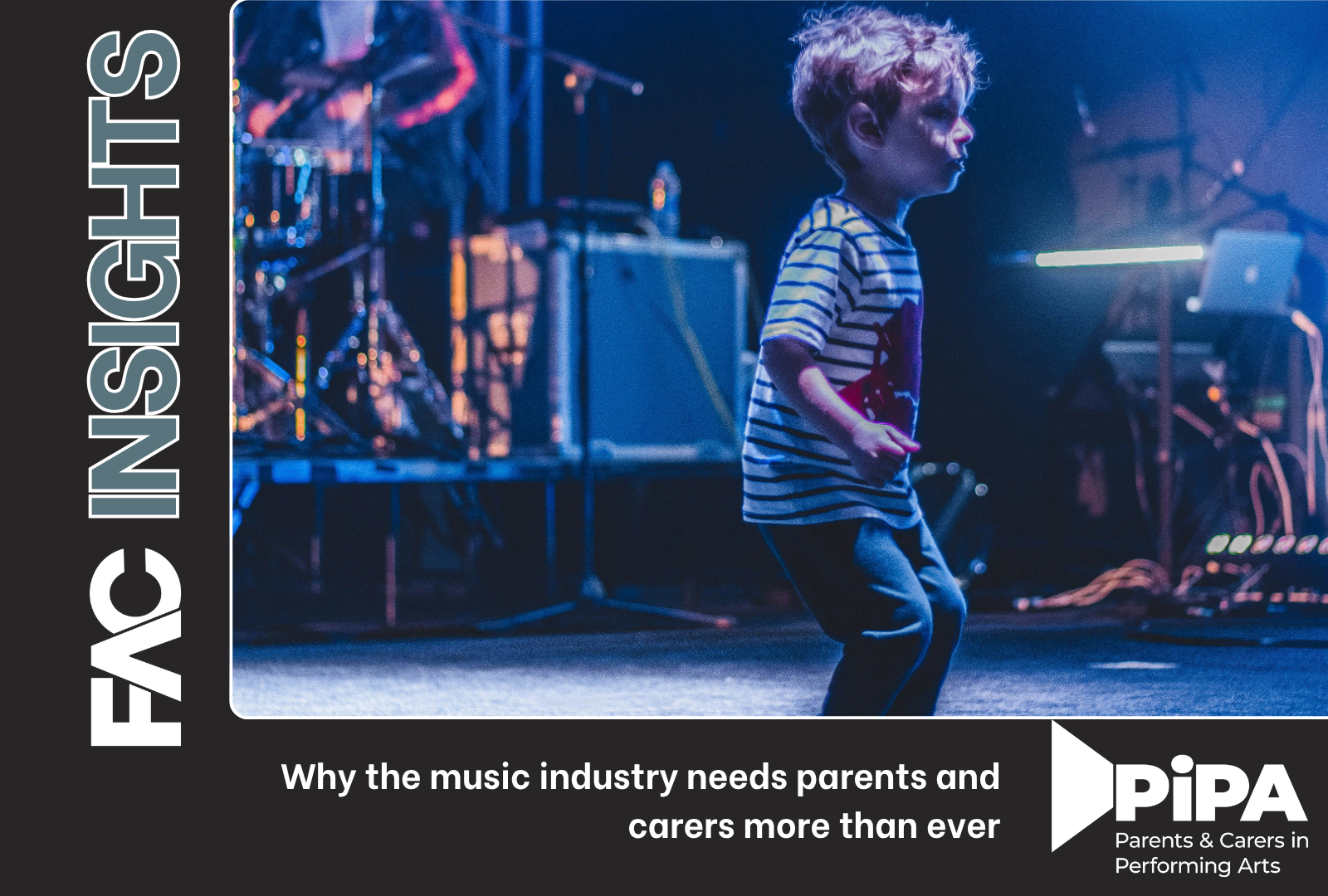
For an industry built on storytelling, music has an overlooked reality. We celebrate heartbreak, joy, rebellion, and reinvention, but rarely acknowledge the realities of caregiving, even though so many of us face them every day. Parents and carers are essential to the cultural fabric of the UK’s music scene, yet remain some of its most unseen and unsupported contributors.
A growing body of research, including the landmark Bittersweet Symphony report (Parents & Carers in Performing Arts, 2023), the Musicians’ Census 2023, and the UK Music Diversity Report, shows that caregiving musicians face entrenched structural barriers that push many out of the sector entirely. Bittersweet Symphony highlights the industry’s assumption of “total availability,” while the Musicians’ Census reveals that nearly one in three musicians with caring responsibilities say it directly limits their ability to work, and that women and disabled musicians are disproportionately affected. The UK Music Diversity Report further identifies caregiving as a major factor in the loss of women and people from marginalised backgrounds at midcareer level, where drop-off rates spike sharply.
These findings, echoed in the lived experiences of artists like Emmy the Great, Oritsé Williams, and Adele, reveal why the industry urgently needs systemic change.
Bittersweet Symphony is one of the most comprehensive studies ever conducted on parents and carers in classical music. The findings are stark and we conclude the industry is built on the assumption of total availability, an assumption fundamentally incompatible with caregiving.
This single sentence captures the core problem. Touring schedules, rehearsal expectations, and the culture of constant hustle were designed for people without dependents. According to the report:
76% of parents and carers say their responsibilities negatively affect their career progression
Nearly half have considered leaving the industry entirely
Financial instability, lack of flexible working, and inaccessible touring structures are the most commonly cited barriers
These aren’t marginal issues, they point to a systemic failure that disproportionately affects women, single parents, and those caring for disabled or elderly family members.
Singer-songwriter Emmy the Great (Emma-Lee Moss) has been one of the most articulate voices on the emotional and professional impact of becoming a parent in the music industry. In a Guardianinterview for PiPA, she described the profound sense of invisibility she felt after giving birth:‑songwriter
“I felt like I had disappeared. I didn’t know how to be a musician and a mother at the same time.”
She speaks about the logistical impossibility of touring with a baby, the financial strain of childcare, and the cultural expectation that motherhood should be private and silent, the opposite of what a public-facing creative career demands.
Caregiving isn’t limited to parenting. Former JLS member Oritsé Williams has spoken openly about caring for his mother, who lives with multiple sclerosis. He said:
“Being a carer and a musician is almost impossible. The industry doesn’t slow down for you.”
Oritsé talks about the emotional strain of balancing a music career with full‑time caring responsibilities and how, at times, he considered leaving music altogether.
His story highlights a recurring theme in our research that around 70% of carers in the performing arts (people who care for adults, ill or disabled loved ones) do not disclose their caring responsibilities, often due to fear of losing work, being perceived as unreliable, or facing discrimination. We call this small, but significant group of individuals “hidden carers” whose needs are significant but likely unmet.
Adele has been open about how becoming a parent impacted her career, and described the decision to have a child as “almost career suicide.” She has spoken candidly about experiencing postpartum depression, the pressure she felt to return to work quickly, and the emotional toll of trying to tour while raising a young child.
Parents and carers are central to the music industry’s long-term strength, creativity, and sustainability. These artists bring depth, nuance, and lived experience that audiences connect with, yet they are too often pushed to the margins by working cultures built on inflexibility and high demands. Their challenges expose the cracks in outdated systems and highlight exactly where the sector must evolve to remain competitive, diverse, and artistically vibrant. Supporting and championing parents and carers is a strategic investment in the industry’s future strength, creativity, and sustainability.
In 2025, we created the PiPA Pledge. The PiPA Pledge offers a practical, evidence-based framework to make that shift possible. It provides organisations with a clear 5-point roadmap for embedding carer-inclusive policies, flexible working models, and equitable support structures that enable talent to thrive rather than burn out or walk away. For an industry that depends on retaining skilled, experienced, and diverse creators, adopting the PiPA Pledge is a baseline commitment, a signal that an organisation is serious about modernising its practices and safeguarding its current and future workforce.
Look for the PiPA Pledge, ask about it, bring it into the rooms you are in. PiPA Trustee and Generator Head of Programmes Thomas Bagnall said recently: https://generator.org.uk/news-and-views/building-a-music-industry-that-works-for-parents “We will only enact meaningful change if the whole sector pulls in the same direction."
To find out more about the different ways to support parents and carers, drop us a line at ceo@pipacampaign.com