
FAC Insights: Beyond the Spotlight: Why Musicians Need Care, Not Just Applause
FAC Insights is a forum for us to showcase and share long form pieces looking at various parts of the music industry and the society that shapes it. Pieces take the form of videos, interviews, discussions, articles and more.
This month, we’re thrilled to feature Revd Peterson Feital in an inspiring piece surrounding mental health in the creative industries.
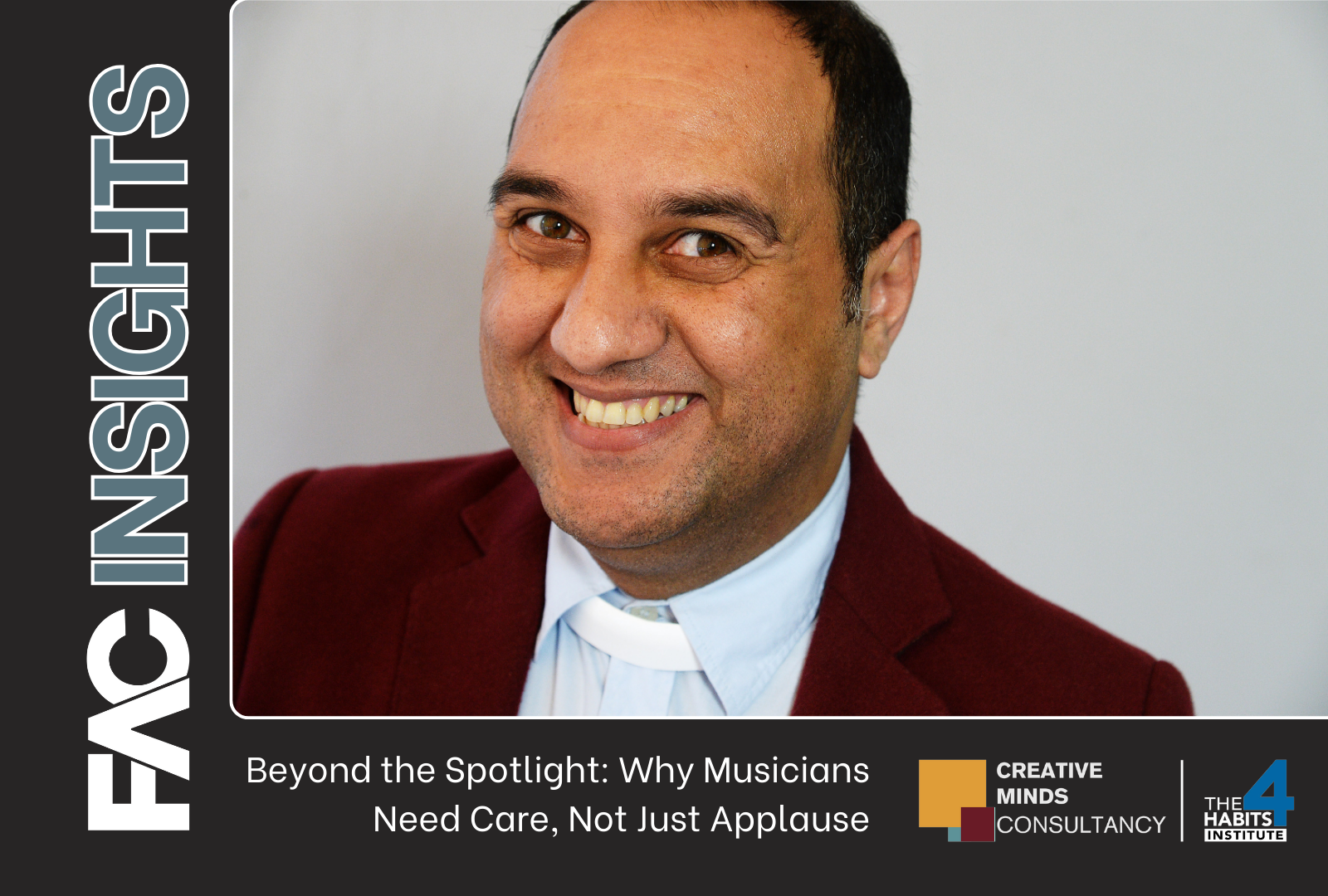
Photographer: Dave Hogan
When I was invited to write for the Featured Artists Coalition, a rush of emotions returned to me: affirmation first, then responsibility. For decades I have worked to create what I call “a safe space to talk” for artists. Now, finally, I had a platform where that work connects directly with an organisation whose mission mirrors my own: ensuringartists are not only represented but protected, empowered and heard.
I am not a singer. I am not a guitarist. I am a Brazilian immigrant, a reverend, and a lifelong listener, someone whose love of music became a vocation. To some, the idea of a brown, immigrant priest advocating for the emotional, psychological and spiritual wellbeing of musicians has been met with curiosity or even scepticism. To me it has always been simple: to truly love an artist, you must learn to listen to the beating heart of their soul.
For years, scholars have explored the connection between creativity and psychological vulnerability. Dr Kay Redfield Jamison, in her seminal book Touched with Fire, observes that many imaginative artists “have always sailed in the wind’s eye,” navigating emotional storms that are often intertwined with the very temperament that fuels their creativity. Her work reminds us that genius should never be romanticised as suffering. Instead, it demands compassion, structure, and understanding.
Modern research reinforces this. Major UK surveys, including the ones led by The Help Musicians and Music Mind Matters, show that musicians experience disproportionately high levels of anxiety, depression and financial instability, particularly early in their careers. Studies highlight concerning suicide rates and the profound toll of precarity, long hours, isolation and emotional labour. All of this points to the same conclusion: artists do not struggle because they are fragile; they struggle because the systems around them are.
The FAC exists to change those systems. Its purpose is to ensure that artists are no longer absent from the rooms where rights, revenues and futures are decided. It calls for an industry built on fairness, transparency and humanity. This mission, to give artists a seat at the table, is the same mission that has shaped my own life’s work.
A Life Shaped by Music and a Calling to Protect Those Who Make It
My relationship with music began when I was five years old. Fleeing domestic abuse, I wandered into a small chapel in my Brazilian neighbourhood, a place I had never entered before. Inside, a tall Black preacher sang an old hymn while elderly women harmonised. The room was filled with sound. The world, which had been grey and frightening, suddenly burst into colour.
That day, music became my refuge. Soon after came Elvis Presley, whom I discovered in an old film. When my choir conductor found a picture of him tucked into my bright yellow Bible, she warned me that Elvis had “started in a gospel choir and ended singing the devil’s music, ” and look what had happened to him. I did not understand then. When I later learned of his tragic life, something inside me broke open.
Why had so many musicians, Elvis, Marvin Gaye, Aretha Franklin, Whitney Houston, Kurt Cobian, Amy Winehouse and so many others, suffered so deeply and so publicly. Why did the purest voices often carry the heaviest burdens. I read everything I could. I listened even more. And I realised that what needed fixing was not the artist but the environment around the artist.
Building Support: The Haven+ and a Legacy of Care
In February 2017, this realisation became action. I founded The Haven+ as a registered charity dedicated to providing pastoral care, crisis intervention and emotional support to the creative sector. I built a diverse board of trustees and appointed a Director of Care to lead safeguarding. We secured funding, formed partnerships across London, and created the Safe Space to Talk programmes.
I recruited and led a multidisciplinary team of chaplains, psychologists, counsellors and mental-health specialists. I trained lay chaplains, developed referral pathways into professional care, and created programmes in partnership with Sikh, Muslim and Jewish leaders so that artists of every faith and none had a place to be seen and heard. Our duty of care to them was central.
From 2017 to October 2024, The Haven+ supported more than 4,000 individuals from diverse backgrounds. We provided over 2,000 hours of one-to-one pastoral care or counselling and intervened directly in more than 30 suicide-risk cases. During COVID, when funding became impossible to sustain, our trustees made a principled decision: use every remaining penny for direct support. We did exactly that, offering emergency hardship funds, therapy, food, practical aid and family support. Human lives, not organisational survival, came first.
Research, Consultancy and Cultural Change
When The Haven + came to an end, I shifted my vision to reform pastoral care and my energy elsewhere, still with relentless focus in three areas.. First, as a Priest in the Stantonbury Ecumenical Partnership in Milton Keynes, I continue to deepen pastoral care for artists while launching a new initiative for young people: a Youth Gospel Choir.
Our Mission is to create a safe space for young people to thrive as they belong in a community, where they grow resilient in their emotional, spiritual, mental, and professional selves to the world.
Our vision is to develop, through Gospel Music, an education about the lives of the musicians and the composers and learn about the spiritual resilience and resistance they had to acquire throughout their lives, which now the Youth Gospelchoir will be performing. Some of our key objectives are to tackle loneliness and social isolation, to nurture the whole person rather than just their talent, and to build self-esteem and self-care through music.
Our programmes unite Gospel music and its rich history with the guidance of mental-health professionals, coaches, teachers and spiritual leaders, equipping young people to face bullying, racism and difference with resilience and confidence. To support this work, I have enlisted musician friends, artists who understand both the pain and the joy of creative life, to help us build something honest, nurturing and transformative.
Secondly ,I worked as a lead researcher at Kingston, and while the research is now complete, the work continues.
We are looking at forming partnerships with organisations to apply these findings, placing a love for artists and a deep understanding of how they work at the centre of pastoral care and HR practices.
My research into Creative Minds and Resilience brings together psychology, economics and spiritual wellbeing to answer a critical question: what conditions allow creative people to thrive? The early findings are clear. Emotional intelligence, financial stability, compassionate leadership and pastoral support are not luxuries. They are infrastructure. As noted earlier, the evidence is unequivocal. UK research consistently shows that musicians face heightened levels of anxiety, depression and financial insecurity, not as a personal failing, but as the consequence of systems that have long overlooked their wellbeing.
That’s where the FAC comes in - to change those systems. And that’s also where the third element of my work is, in partnership with Dr. Andrea and Jonathan Taylor-Cummings at The 4 Habits Institute.
A Shared Vision for Culture Change
Our partnership is built on a shared conviction: that if we want healthier, high-performing creative environments, we must address the root behaviours that create either harm or healing. Lasting culture change begins with the courage to change how we show up—individually and collectively. When leaders learn to unlearn toxic habits and model new ones, we don’t just create better workplaces—we reshape what’s possible for artists and the industry alike.
At The 4 Habits Institute, Andrea and Jon have spent over 25 years helping leaders shift from toxic tolerance to compassionate leadership.
Together, we help broadcasters, studios, record labels and arts organisations develop emotionally intelligent leadership, conflict resolution frameworks and practical tools for supporting artists. We train CEOs, agents and managers to understand not only the brand of the artist, but the mind, heart and soul behind the work.
Where traditional training often scratches the surface, our approach goes deeper—equipping leaders with four key habits that reduce friction, deepen trust, and create the psychological safety every creative mind needs to thrive:
Be Curious, not Critical
Be Careful, not Crushing
Ask, don’t Assume
Connect, before you Correct
Through a structured, layered approach to learning and behaviour change, leaders and teams are supported to shift from reactive habits that damage relationships to intentional habits that strengthen them. These simple, memorable behaviours become a shared language for holding each other accountable - and forming the cultural infrastructure needed to build trust, inclusion, and wholeness in high-pressure creative spaces.
At the BBC, a senior leadership team saw powerful results. After engaging with The 4 Habits, communication and psychological safety improved dramatically—and engagement scores jumped from below average to the top percentile across the organisation. That balance of high performance and humanity is possible. It’s not a trade-off. It’s the goal.
As Andrea and Jon often say, “We don’t do training. We do transformation.”
From Safe Spaces to Safe Systems
This work continues the legacy of The Haven+ - but now with expanded tools, deeper reach, and a collaborative approach that addresses both crisis and culture.
Together, we are building environments where:
CEOs learn to lead with empathy
Managers learn to challenge without shaming
Teams learn to support without enabling
And artists, finally, are not just cared for in crisis - but empowered to flourish by design
Why I Stand With the FAC
All of this leads back to why the FAC matters. Its mission, to represent artists’ rights, amplify their voices and reshape the industry, is inseparable from the work I have done for years. Artists deserve fair pay, fair treatment, safe working conditions, emotionally literate leadership and a genuine place at the table.
If you love music, you must care for the people who create it.
If you love the sound, you must honour the soul behind it.
And if you want the industry to flourish, you must build systems that allow artists to flourish too.
The FAC is one of the few organisations committed to making that future possible. I am proud to stand with them as a reverend, an immigrant, a listener and someone who has spent a lifetime hearing the quiet, sacred stories behind the music we all love.