
FAC Insights: The power of music: why music therapy matters for mental health
FAC Insights is a forum for us to showcase and share long form pieces looking at various parts of the music industry and the society that shapes it. Pieces take the form of videos, interviews, discussions, articles and more.
In this piece, Dr Maria Neophytou, CEO of Nordoff and Robbins, explores how music therapy can support mental health, helping people rebuild confidence, express themselves and reconnect with others. She also shares a powerful example of its impact and highlights the importance of making music therapy accessible to more people.
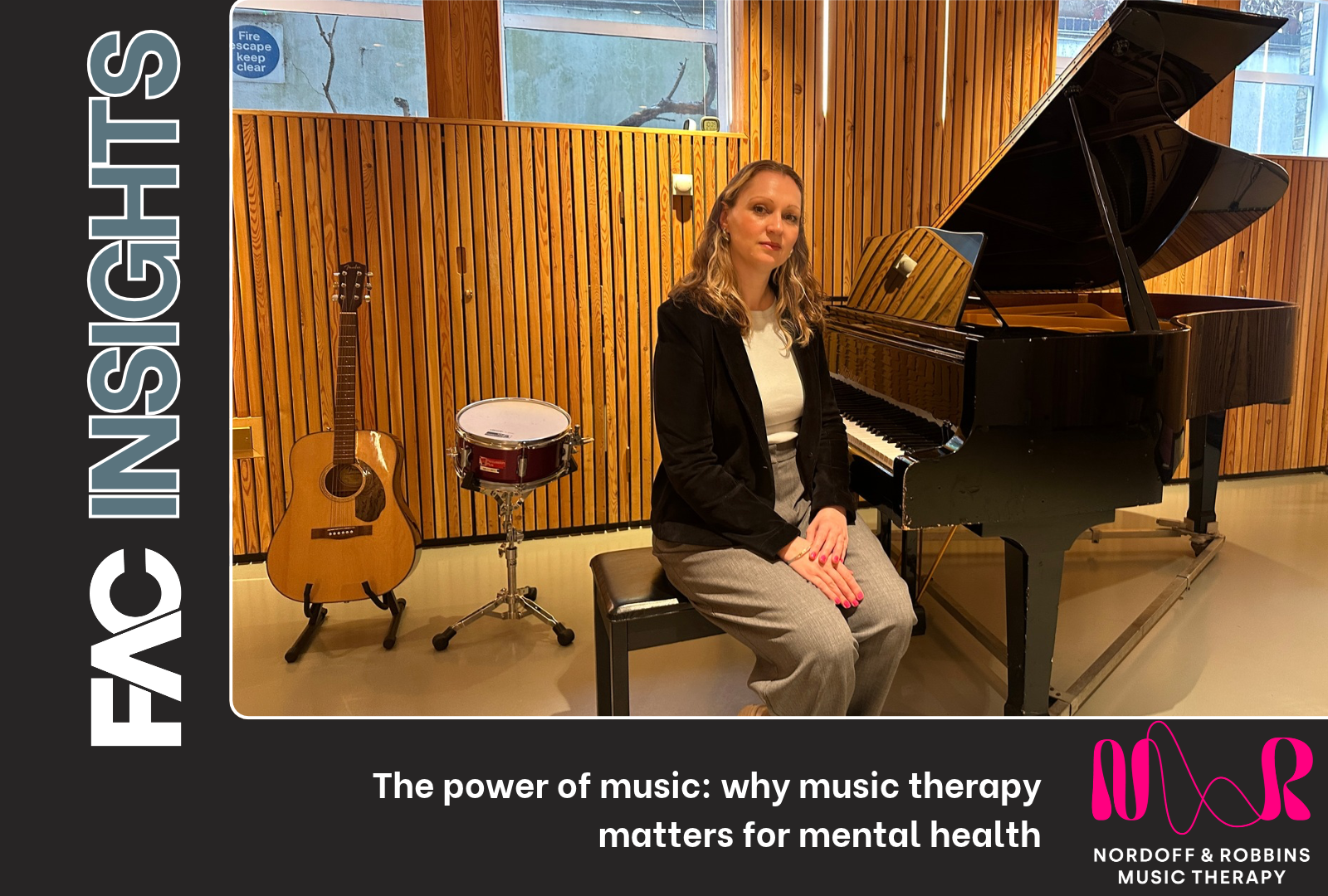
Whether you are playing your first grassroots venue, releasing music independently, building a fanbase, releasing a single or touring internationally, you’ll know something instinctive about music: it can change what feels possible. It can steady us, energise us, connect us to memory, help us express what words cannot, and bring people together when conversation feels impossible. For musicians, that power is lived every day. And for thousands of people facing mental health challenges, isolation, illness, or trauma, music can be more than a source of comfort. In the hands of a trained music therapist, it can become a route back to connection, self-belief and a fuller sense of possibility.
Nordoff & Robbins has been training music therapists for over 60 years and now delivers music therapy in schools, care homes, community centres, prisons, basically anywhere where we can make a difference. Music therapy is not about teaching someone to be technically good at music. It is a regulated, evidence-informed therapeutic practice, delivered by trained professionals who understand how music interacts with people’s psychological, emotional, cognitive, physical, communicative and social experiences. Our approach is rooted in what can happen when people meet through music. Therapist and participant create music together, listening and responding to one another in the moment. In that shared music, people can communicate, express themselves, make choices, take risks, connect and be heard in ways that may not always be possible in everyday life. Music is not simply a tool for delivering therapy; it is one of the most instinctive ways we have of relating to ourselves and one another.
Why music can reach people differently
The impact of poor mental health can extend far beyond symptoms. It can affect our sense of identity, agency, relationships and limit our ability to take part in life. At times, our sense of what is possible can narrow: we may withdraw from others and ourselves.
This is one reason music is so important for mental health. When our sense of what is possible has narrowed, making music with another person can create a different kind of experience. We are not defined by a diagnosis, but by what we bring to the music: our ideas, our voice and our capacity for connection. Music therapists listen to what a person brings and make their creative contribution central to what happens in the music. Over time, those possibilities, choices and forms of participation can extend beyond the session, enabling people to reconnect with the people and activities that mental health may have obscured.
The wider evidence base is growing too. The World Health Organisation has highlighted the role of the arts in supporting health and wellbeing. Recent evidence reviews point to the potential of music therapy to reduce anxiety and support people experiencing depression, while continuing to underline the need for high-quality research and careful implementation. This matters because people need more than crisis responses. Prevention is also about creating the conditions that support people to remain well, and navigate difficult periods when they arise. People need human, relational and accessible support that helps them stay connected to themselves, to others and to everyday life, including when life is difficult.
John’s* story: restoring a voice, a musical identity and a place in the world
One of the clearest examples comes from our work with Barnabus, a homeless support centre in Manchester providing practical, medical and long-term holistic support. Nordoff & Robbins delivers weekly music therapy at the Centre, through one-to-one sessions and an open group.
John first came to music therapy in his 60s while experiencing street homelessness, profound low mood, suicidal thoughts, low confidence, social isolation and unresolved bereavement. He also had a deep musical history, but trauma and difficult life circumstances had disconnected him from that part of himself.
At first, even sitting at the piano felt too much. In the safety and consistency of one-to-one music therapy, John was able to participate without pressure, communicate at his own pace and gradually explore what felt possible. Through improvisation, singing and shared music-making, his therapist supported him to express complex emotions and rebuild confidence in his ability to engage and create.
This individual work strengthened John’s confidence in the Barnabus group too. He began taking creative risks, contributing more readily to shared music-making and engaging more confidently with others. The one-to-one sessions gave him space to build trust and practise, while the group offered a social and creative place to use that growing confidence.
What followed was extraordinary. Music therapy helped John reconnect with who he was. He became a regular, creative presence in the Barnabus group, practised independently on a public piano at Manchester Central Library, borrowed complex music scores and brought them to sessions. With support from his therapist, he performed at Barnabus Christmas showcases, helped co-write and record an original song, performed with Streetwise Opera at The Lowry, played piano on stage for West End performers from The Choir of Man at Manchester Opera House, and most recently performed at a Suicide Prevention Day Vigil in Salford.
In John’s own words, music therapy helped bring about the “reconstruction of my voice” and the “restoration of my hands on the keyboard”. He spoke of feeling whole again. His story shows the power of music therapy at its best: a bridge back to agency, community and hope.
The impact we see
Across our mental health evaluations, drawing on feedback from 412 respondents, 90% said music therapy improved their mental health, 93% said it enhanced their quality of life, 95% said it developed their social skills and interaction, and 89% reported increased confidence and self-esteem. Behind each of those figures is a person who has been able to take part, make choices, be heard and experience their own capacity for connection and creativity.
A call to artists and the wider community
You understand better than anyone that music is not a luxury. It is a craft, woven into identity, and an essential means of human connection. But too many people who could benefit from music therapy still do not know it exists, and too many services that support people in crisis do not have access to it.
That is where you can make a difference. A conversation after a gig, a post to a small but engaged audience, a relationship with a local venue, a collaboration with a community project, or simply choosing to speak about the therapeutic power of music can all help shift awareness. Together, these actions can make music therapy part of a bigger conversation about mental health, community and belonging.
If you would like to find out more about our work, or how you can help raise awareness of music therapy, please email communications@nordoff-robbins.org.uk.
* Name has been changed to protect the individual’s identity.