
FAC Insights: Class Ceiling | Examining class barriers in the arts
FAC Insights is a forum for us to showcase and share long form pieces looking at various parts of the music industry and the society that shapes it. Pieces take the form of videos, interviews, discussions, articles and more.
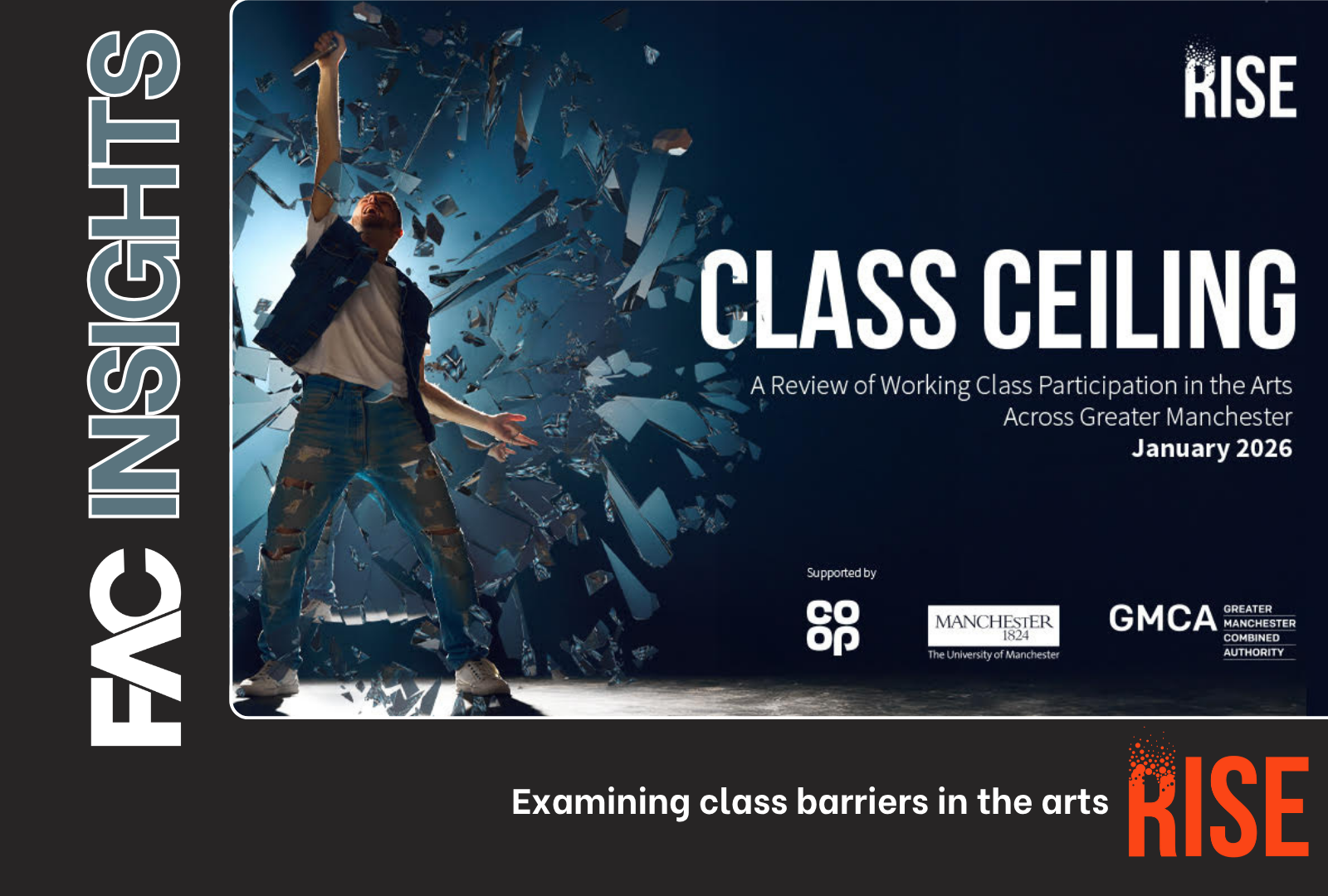
In this piece, we're pleased to feature Matt Baker, founder of RISE Associates, who were commissioned to undertake the Class Ceiling report. Matt explores the barriers preventing working-class talent from succeeding in the arts across Greater Manchester, drawing on extensive research and interviews with artists and arts workers. He also highlights the changes needed to create a fairer, more inclusive arts sector where talent can thrive regardless of background.
Can you give us an overview of the Class Ceiling report and what inspired the research?
Our Class Ceiling review is the first place-based study to examine the barriers preventing working class talent from succeeding in the arts in Greater Manchester. We carried out considerable quantitative and qualitative research including almost 200 hours of interviews with artists ranging from teenage musicians and mid-career arts workers to globally recognised playwrights and BAFTA and Emmy winning screenwriters to seek to understand the challenges facing working class artists in our region.
What inspired it? Several things. Firstly, we are all passionate about social mobility at RISE and want talent to shine. We recognise that shrinking working class participation in the arts is a national challenge, but in Manchester it poses something of an existential problem. This is a region that’s built on working class talent. Its identity is inextricably bound up in the creative output of working class stars and the region markets itself on its music and creative vibrancy. If that talent pipeline dries up and working class artists are shut out then investment will decrease, we’ll lose our lustre and risk becoming just another beige place.
We are also tired of reading national reports and wanted to develop a place based solution and work with local policymakers and organisations to make a difference.
What are the key findings that you hope readers take away from the report?
Our report is publicly available here and we’d encourage everyone to read it. At a time when the creative sector is one of the fastest- growing parts of the UK economy and Manchester is the fastest growing city region, its findings show not everyone is benefitting.
They reveal multiple barriers preventing working class talent from succeeding included class-based discrimination, low pay, a lack of connections and exploitative practices. In a region brimming with creative talent, we found a system that was repeatedly failing people of all ages. But we also found some good practice that should be supported if we are going to break the class ceiling.
Was there a particular finding or statistic that surprised you most during the research? Why? And what does this tell us about the current state of the arts sector?
We were not so much surprised as shocked to see class-based discrimination was commonplace. Over half of respondents to our survey said they had experienced differential treatment, bullying, harassment or bias based on social class or perceived social class. We were aware of the structural unfairness but not the prejudice. It is really disappointing to hear people recount how they were mocked because of their accent and lack of wealth. We heard multiple accounts of people being ‘othered’, offered voice training because they had a regional dialect or told they sounded ‘thick’ because of their northern accent. Some of it was really ugly and it’s a key driver behind so many working class creatives leaving the arts.
What does this tell us about the current state of the arts sector? It shows there’s a troubling groupthink and a stunning lack of understanding about other people’s lives. Or, as one contributor put it, “It’s not a meritocracy, it’s a mirrorocracy. The commissions go to people who are similar to those in charge. They want to see what they think reflects them.”
The report highlights barriers such as low pay, limited industry connections and a lack of representation. Which of these do you believe is the biggest challenge for working-classcreatives, and why?
It has to be pay. Less than half of the creatives that we surveyed (44%) said they made enough to make a living and we know the staff at many arts organisations are subsidised by their parents because the wages are so low. Of course, not everyone can be funded by the bank of mum and dad, and this is a huge barrier to working class kids deciding to pursue a career in the arts. People just can’t afford to live. There’s also a culture of expecting people to work for free on internships and placements. Again, this makes it impossible for people who can’t rely on parental subsidy and it locks out a huge amount of working class talent.
Your report also showcases examples of initiatives that are making a difference across Greater Manchester. Are there any projects or approaches you think should be expanded or adopted more widely?
The findings make difficult reading, but there is also lots of good practice. The work of GRIT studios, for example, in turning empty buildings into affordable arts studios is genuinely inspiring. Certainly this approach to bringing empty buildings back into use is something that should be expanded. Community owned music venues, such as the Snug in Atherton, is another good example. So too is the Fair Play programme to encourage more working class leaders in theatre. There are also 'access riders' to champion working class artists’ needs. And music promoters championing fairer fee distribution to help bands earn more. There are lots of great initiatives happening. But we need to scale them up so they can help even more people.
What changes would you like to see from arts organisations, employers and policymakers as a result of this report?
We’d like employers to break the practice of informal hiring and establish a fairer wage, paid placements and more permanent roles. And we’d like policymakers to put class at the centre of arts policy and strategy.
For too long now, class has been an overlooked element in the EDI landscape, and it needs to be treated as a core inclusion issue. This will require publishing socio-economic data, publishing targets and making pay transparent. Combined, this will expose the filters that block progress.
We’ve included 21 recommendations in our report and all of which will help make a huge difference in levelling the playing field, spreading opportunity and making sure all talent has a chance to succeed.
Looking ahead, what does success look like? If these recommendations were implemented, how would Greater Manchester's arts sector be different in five or ten years' time?
All of our recommendations were accepted by the then Mayor of Greater Manchester, Andy Burnham. But he’s now left to become Prime Minister so much depends on who will succeed him! If these recommendations are implemented – and there is already work underway to achieve this – then we’d like to see our region have a stronger grassroots scene, better paid opportunities and more young people from working class backgrounds actively pursuing arts careers. If that happens then I hope there will be less focus on just the city centre and a genuine revival in the surrounding towns, making Greater Manchester a better place for all.